
The innovation showcase ran for ninety minutes and everybody clapped. Eight teams, eight demos, a chatbot that answered policy questions, a model that summarised contracts, a tool that drafted marketing copy in the brand voice. The COO clapped too. Then, on the drive home, she did the arithmetic she had not done in the room. Eight pilots. Three of them more than a year old. Not one of them had changed a single number she reported to the board. The applause had been real. The value had not.
This is the quiet condition of most AI programmes in 2026: a great deal of motion, very little movement. Pilots have become a performance - visible, fundable, applauded - and performance is mistaken for progress. The mistake is understandable. A pilot is satisfying. It produces a demo, a champion, a slide. What it rarely produces is a decision to scale, because nobody built the case for scaling into it. MIT/Project NANDA's enterprise GenAI research found that the overwhelming majority of pilots produce no measurable impact on the profit-and-loss account. Not because the technology failed. Because the pilot was never pointed at the P&L in the first place.
A pilot answers the question "can the technology do this?" It almost never answers the question that matters: "does this create value we can measure, own and defend?"
Quick answer
AI theatre happens when pilots, demos, and showcases create the appearance of progress without changing a board-level number. The way out is a value-pool portfolio: every AI initiative must name the business value it serves, the metric that will prove it, and the executive owner accountable for the result.
What pilots usually miss
Here is the uncomfortable diagnosis. A pilot answers the question "can the technology do this?" It almost never answers the question that matters: "does this create value we can measure, own and defend?" Those are different questions, and the gap between them is where budgets go to die. BCG's Build for the Future work is blunt about the consequence: a small future-built minority captures scaled value while most organisations remain busy with activity that does not compound. In Green Everest's shorthand, this is the 88/6 problem. The 94% are not short of pilots. They are drowning in them.
The 6% run the conversation the other way round. They do not start with a list of use cases and hope value emerges. They start with the value and work back to the use cases that serve it. DBS Bank is the cleanest example: by 2024 it ran more than 1,500 AI and machine-learning models across 370-plus use cases and attributed over SGD 750 million in economic value to them - not because it piloted more than everyone else, but because it governed AI as a portfolio tied to value, and killed what did not earn its place. The shift is from a pilot list to a value portfolio. It changes everything downstream.
Use the value-pool heatmap
The instrument that makes the shift concrete is the value pool heatmap. It is deliberately simple, because it has to survive a boardroom. Down the side, five places value actually lives: Revenue Growth, Productivity, Risk and Compliance, Customer Experience, and Strategic Advantage. Across the top, five questions every candidate must answer: What is the impact if it works? How feasible is it? Is the data ready? What is the risk? And - the column that ends most debates - who owns it?
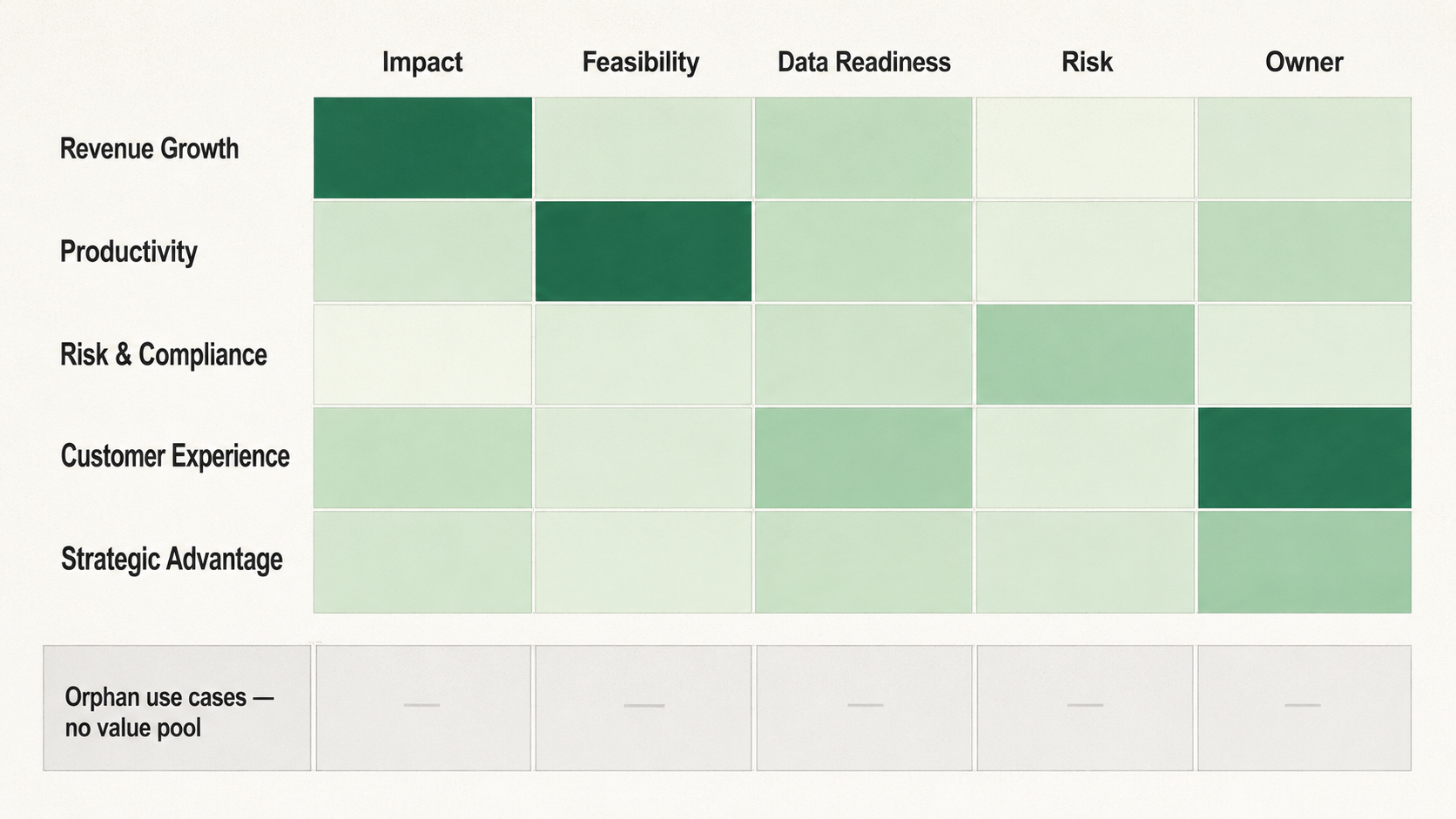
Every AI initiative gets scored and placed. The heatmap does two things at once. It shows the leadership team where the real value is concentrated, usually in two or three pools rather than spread thin across ten. And it exposes the orphans: the technically interesting initiatives that cannot name a value pool, a number, or an owner. Those are not strategy. They are theatre with a budget line.
Spot the orphan use case
The orphan use case has a signature, and finance always finds it. It sails through the showcase because it is clever and nobody challenges the assumption that it will "somehow" pay back. Then it reaches the first review, the CFO asks for the metric that proves the return, and the room goes quiet - because the value connection was never designed, only assumed.
No initiative enters the portfolio until it names three things.
Its primary value pool, its expected annual value in rands, and the single metric that will prove it. Miss any one, and it is not ready.
This is also where measurement stops being an afterthought and becomes the point. The reason the COO could not connect eight pilots to a single board number is that none of them was instrumented to be connected. The 6% build the telemetry before the build - they capture the baseline in the three months before go-live, so that when someone asks "did it work?", the answer is a comparison, not an opinion. A pilot without a baseline produces a number. A pilot with a baseline produces evidence. Only one of those survives a budget cycle.
Three questions for the leadership team
For a leadership team, the move from theatre to value does not require more spend or another platform. It requires a harder conversation, structured around three questions:
If we mapped every AI initiative onto a value pool, how many would land in Revenue, Productivity or Risk with a rand figure attached - and how many are orphans we keep funding out of momentum?
For our three biggest AI bets, can we name the baseline we measured against, or are we comparing the result to a memory?
Who owns the value of each initiative - not the technology, the value - and would they sign their name to the number?
The honest answers usually shrink the portfolio. That is the point. A focused portfolio of value pools, each owned and measured, will out-perform a sprawling estate of admired pilots every time - because focus is what converts adoption into impact. The applause at the showcase is not the problem. The problem is mistaking it for a return.
The era of AI theatre is ending, and the organisations that thrive in what comes next will be the ones that learned the difference early. A use case without a value pool is just activity.
FAQ
What is AI theatre?
AI theatre is visible AI activity that looks impressive but does not change a measurable business number. It often shows up as pilots, demos, showcases, or tools that have no clear value owner.
What is a value pool in AI strategy?
A value pool is a place where AI can change the economics of the business, such as revenue growth, productivity, risk and compliance, customer experience, or strategic advantage.
How should leaders decide which AI pilots to scale?
Scale the pilots that can name a primary value pool, expected annual value, baseline, success metric, feasibility case, data readiness position, risk profile, and accountable owner.
Where does AIO Compass fit?
AIO Compass turns a scattered pilot list into a board-ready value-pool portfolio. It helps the leadership team choose the few AI initiatives that deserve funding, ownership, and measurement.
How many of your AI initiatives could name their value pool, their number and their owner today? The AIO Compass engagement turns a pilot list into a board-ready value-pool portfolio in four to six weeks - so your next showcase ends with a number, not just applause.
Sources: MIT/Project NANDA, The GenAI Divide: State of AI in Business 2025; BCG, Are You Generating Value from AI? The Widening Gap; DBS Annual Report 2024, AI and machine-learning economic value.